
How to localise a brand to fit an audience, not just its language

Thomas Chan · Bilingual content strategist and UX writer
8 years building bilingual English and Chinese content across fintech, crypto, eCommerce, NGOs, banking and insurance
PMI-ACP® certified. MA International Public Affairs, HKU and MComm in Marketing, UNSW
A team ships its content into a new market. Professionally translated, terminology checked, not a single sentence wrong. It lands with a thud, and nobody can quite say why.
I've been on both sides of this. The translation usually isn't the problem. It's that the content was built for a reader who lives somewhere else, reads on different platforms and worries about different things. And nobody ever tells that reader why this particular brand is relevant to them.
This guide is about closing that gap, using four fintech brands competing in Hong Kong that each solve a different part of it.
The end goal of all localisation
Localisation that stops at accurate translation is only doing half the job. Getting local idioms and expressions right matters. But the more important half is fitting what your local audience actually does and wants. That means running the same context and purpose questions as UX writing generally, applied one market at a time, rather than settling for what the audience would technically understand from a correct translation.
The data backs up why language is the floor rather than the ceiling. Don DePalma's CSA Research has anchored this argument for nearly two decades through its "Can't Read, Won't Buy" study. Their 29-country survey of 8,709 consumers found 76% prefer buying from content in their own language. And 40% say they'll never buy from a site in another language at all. That's the baseline every brand entering a new market has to clear.
But clearing a baseline isn't a strategy. What happens after it is where your differentiation actually sits. I made this point on the TransPerfect NEXT Singapore panel: localisation means moving beyond the words and into what you actually show each market. If a Singaporean fintech expanding into Hong Kong translates its content into Traditional Chinese, or writes an article about investing in Hong Kong in English, and calls it done, that is the bare minimum. Hong Kong audiences read different platforms, care about different parts of financial literacy, and don't have a local equivalent for every Singapore reference point.
76%
Prefer buying from content in their own language
40%
Will never buy from a site in another language
3.7
Average number of MPF accounts per Hong Konger
What Endowus did, and what was missing
When I worked on Endowus's Hong Kong expansion, our approach centred on localising articles from the existing Singapore library and writing new long-form pieces on the Hong Kong investment market. It worked in a specific sense. We swapped the Central Provident Fund (CPF) for the Mandatory Provident Fund (MPF), and several articles were genuinely aimed at Hong Kong pain points rather than Singapore ones.
What was lacking is just as instructive. Chinese content stayed less prominent than our actual traffic justified, even though most impressions and visitors came from a Cantonese-speaking audience. Articles skewed academic and high-level rather than conversational. Social media was thin next to the long-form content it should have been amplifying. And most articles stayed static, written once and never revisited. The tie-in to why Endowus specifically mattered came right at the end, if at all.
If I led it again, I'd add a clear call to action and state the Endowus-specific relevance much earlier, instead of saving it for a conclusion nobody necessarily reaches. That one change would let the same content work at both the consideration and conversion stages, not just awareness.
What it did achieve is worth stating plainly, because it shows the ceiling of getting language right without the rest. The localised library ran across 9 channels including eDM (electronic direct mail), web pages, SEO blogs and WeChat. Retirement articles scored 4,000-10,000 impressions each in Google Search Console. Finlit-derived social posts drew 10% more impressions than posts of other kinds. Good numbers. They'd have been better with the relevance stated up front.
Endowus's approach
Localised Singapore articles for Hong Kong, swapping CPF for MPF and aiming at local pain points. Effective, but Chinese content stayed less prominent despite most traffic coming from a Cantonese-speaking audience, articles ran academic and static, social media was thin, and Endowus's own relevance rarely surfaced until the very end of the piece.
Syfe's approach
Converts better by staying tied to the audience throughout, explaining early why Syfe specifically solves the reader's problem, with worked examples rather than saving the pitch for a conclusion.
What Syfe does differently
Syfe is a Singapore-headquartered robo-advisor that made Hong Kong its first market outside Singapore. It stays tied to the audience throughout a piece rather than pivoting to the pitch at the end. It explains early and concretely why Syfe solves the specific problem the reader came in with, uses worked examples, and keeps tying those back to the Hong Kong user's everyday problems.
How Syfe and StashAway localise on Instagram
Both Syfe and StashAway localise their brand message on Instagram in a way that's genuinely bite-sized for a busy Hong Kong investor. StashAway's Hong Kong campaign ran under the tagline "You Do Life, We Do Investing", built with creative agency Omelette Digital and marketing consultancy EurekaX. Both position around high-yield products with high mobility, and both work with relatable everyday affiliates in quick succession, carrying the brand points from their articles across and converting many of their Chinese pieces into organic Instagram posts. The aim in each case is squarely at Gen Y aspirations around travel and financial freedom rather than generic wealth messaging.
https://www.instagram.com/p/DVQoJqZkjgB/
https://www.instagram.com/p/Da2ek1UBZ6P/
Bowtie: the fully local brand
Bowtie, a fully local Hong Kong virtual insurer, combines that same audience-first instinct with fully SEO-optimised articles and interactive calculators. A reader works out their own numbers on the page instead of reading someone else's hypothetical example and doing the maths themselves.
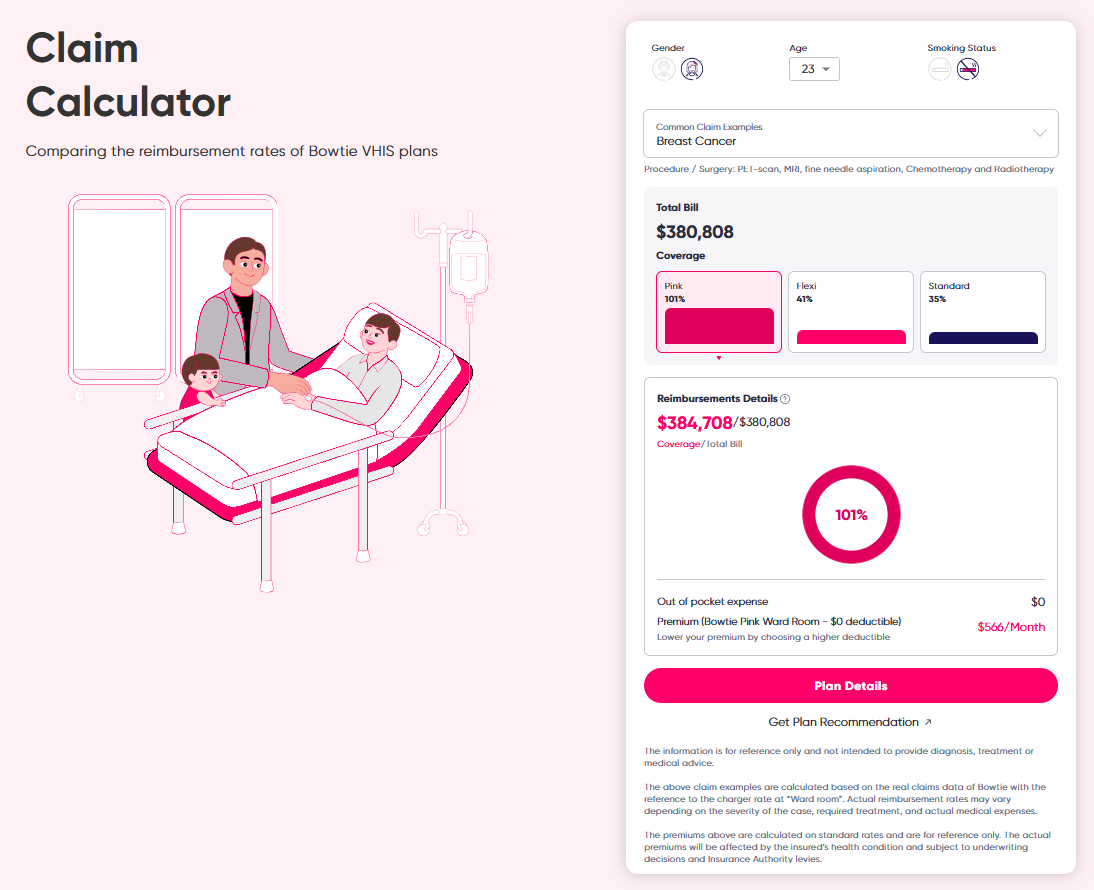
English
Bowtie Hong Kong — the claim calculator in English, running a reader's own numbers instead of a generic example.
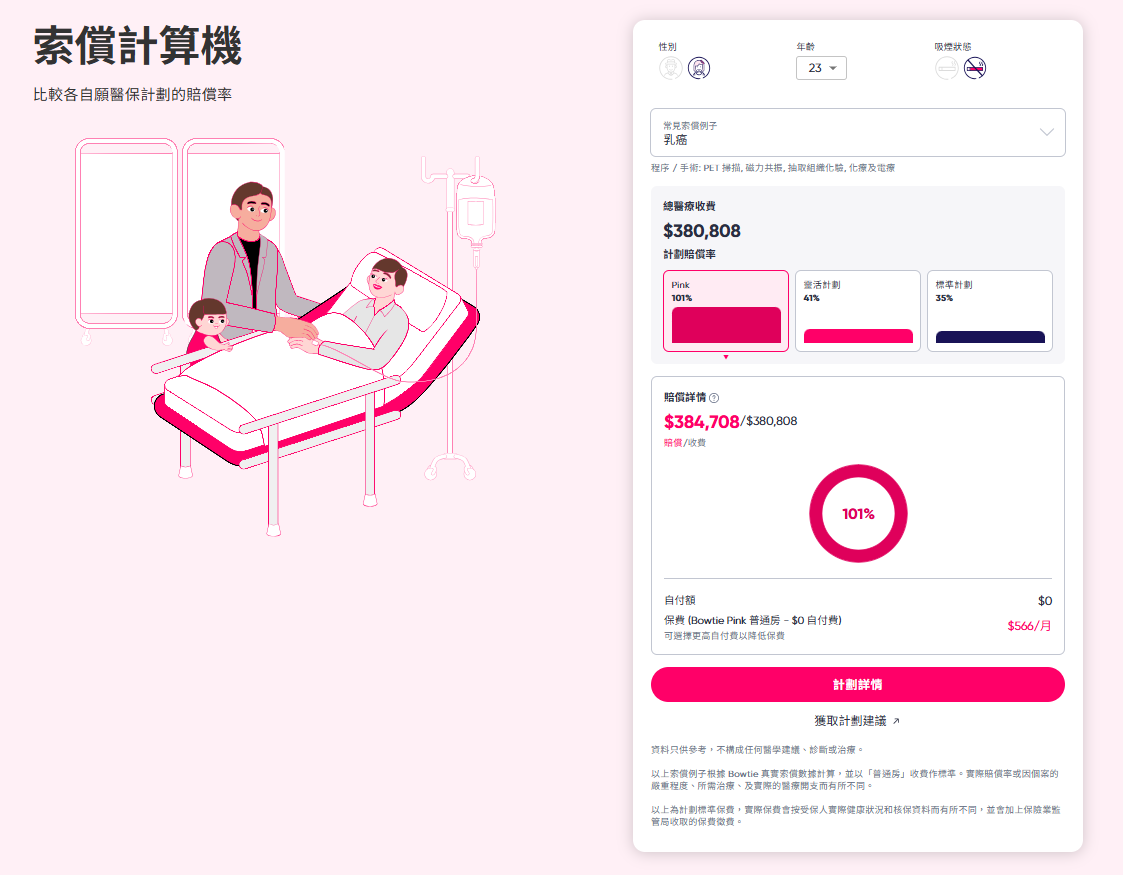
Traditional Chinese
Bowtie Hong Kong — the same calculator, built natively in Chinese rather than translated from the English version.
What a fully localised infrastructure looks like
So what would you actually build? Between them, these four brands demonstrate a three-part infrastructure. Content that's genuinely audience-driven in both language and stated relevance, backed by a consistent social media presence rather than an owned-channel afterthought, and combined with prominently placed interactive elements like calculators that let your user see their own situation.
Here's the build spec I'd suggest:
Disclaimer: these figures are for illustrative purposes only and are not indicative of the actual return likely to be achieved by any product or portfolio.
Assumed context
- Market
- Hong Kong
- Audience
- Working Gen Y investors, time-poor, mobile-first, bilingual with Chinese as the dominant reading language
- Product
- A wealthtech product entering Hong Kong from another APAC market
- Local hook
- The average Hong Konger holds 3.7 MPF accounts
- Languages
- English and Chinese, each written natively rather than translated from the other
Structure
- H1 states the local problem in local terms (MPF consolidation, not 'retirement planning')
- First 2 sentences answer the H1 directly, no preamble
- Brand relevance stated by paragraph 3, not saved for the conclusion
- Every H2 written as a question a real person would type or ask aloud
- One interactive element embedded mid-article, not appended at the end
- Local regulatory terms used consistently throughout, not just on first mention
- Closing CTA that connects the article's specific insight to the product's specific role
Length
- 1,200-1,800 words, Chinese version written natively at equivalent depth
Avoid
- Academic register
- Generic APAC framing that could apply to any market
- Saving the product's relevance for the final paragraph
Structure
- Hook line naming the local pain point in under 8 words
- One number that makes the pain concrete (the 3.7 accounts figure, or equivalent)
- One benefit line stating what changes if they act
- CTA verb-first, under 5 words
- Visual carries the number, copy carries the meaning. Never duplicate the same message in both
Variants
- Minimum 2 per language for A/B testing, differing on hook (pain-led vs aspiration-led), not on CTA
Avoid
- Translating the English ad into Chinese rather than writing the Chinese ad natively
- Financial jargon that fails at a glance on a phone
- Aspiration imagery with no local signal in it
Structure
- Opens on an observation or a question, not a product claim
- Carries one idea only, readable without expanding the caption
- Uses the same local hook as the article, framed conversationally
- Ends on a discussion prompt or a soft link, not a hard CTA
- Format: carousel or single card, sized for in-feed reading, text legible without zooming
Cadence
- Should reference or repurpose the article's insight, so the two channels reinforce rather than run separately
Avoid
- Reposting the paid ad copy verbatim as organic
- Corporate register in a feed built on personal register
- Posting long-form links with no standalone value in the post itself
Here's the checklist version, worth running any new-market content plan against before it ships:
- Audience-driven language and relevance, stated early rather than merely accurate by the end
- A real social media presence, rather than long-form syndicated to social as an afterthought
- Interactive elements, calculators or equivalents, that use the reader's own numbers
- Local terminology swapped correctly and used consistently throughout, past the first mention
- A CTA that ties the content's insight back to why this brand is the one to act with
What is holding several MPF accounts costing you?
Answers on load. Three facts about you, no forecasting asked of you.
Show the assumptions
Illustrative only. A compound projection from the assumptions above, which you can edit. The fee on scattered accounts is modelled as the consolidated fee plus a drag for each extra account, since smaller balances tend to sit in higher-cost default funds. MPF fund expense ratios vary by scheme — check yours. Not financial advice, and not a forecast of any specific scheme.
The pattern across all four brands is easier to see once you stop treating localisation as a language problem. Endowus got the terminology right and still left conversion on the table. Syfe converts because it keeps answering "why does this matter to you, here" throughout the piece. StashAway found a register that fits how Hong Kong Gen Y actually talks about money. Bowtie gives people a calculator instead of an explanation.
None of that is a translation decision. It's a strategy decision that happens to involve two languages. Worth knowing which one you're actually making.
What I'd take into any new market is the sequencing. Get the language right first, because 40% say they'd never buy from a site in another language at all. Then work out what the local audience is actually anxious about, which platforms they're on, and how early you need to say why you're relevant. That last one is usually the cheapest fix and the one most often missed, because a piece can read perfectly well in both languages and still never tell the reader why they should care about the brand behind it.
Is localisation just translation with extra steps?
No. Translation is the floor, not the differentiator. CSA Research's data shows 76% of consumers prefer their own language, but hitting that bar alone doesn't fix content that's too academic, under-represented on the platforms the audience actually uses, or slow to state why the brand is relevant.
How do you know if a market needs a genuinely new content strategy versus a translated one?
Check where the traffic and language mismatch. If most visitors read in a language the content under-serves, or engage on platforms the brand barely uses locally, translation alone won't close that gap.
What's the fastest fix for content that's "localised" but underperforming?
State the brand's specific relevance earlier in the piece. It's a smaller lift than a full content rebuild and directly affects both the consideration and conversion stages of the funnel.
The localisation checklist
Audience-driven language and relevance
Content is written in the language your traffic actually uses, not just the language your head office defaults to, and states why the brand is relevant to that reader early rather than at the end.
A real social media presence
Bite-sized, platform-native content, not just long-form articles syndicated to social as an afterthought.
Interactive elements
Calculators or similar tools that let a reader see their own numbers, not just someone else's example.
Local terminology swapped correctly
The right local instrument names and regulatory terms (MPF instead of CPF, for a Singapore-to-Hong-Kong move) used consistently, not just on first mention.
A CTA that ties back to relevance
A clear next step that connects the content's insight back to why this brand, specifically, is the one to act on it with.
Fit the audience, not just the language
The brands that win a new market aren't the ones with the most accurate translation. They're the ones whose content reads like it was written for that market from the start: right platforms, right terminology, right pace, and relevance stated up front instead of hoped for at the end.
Want this run on your content?
The first audit is complimentary. Two days from kickoff to write-up.
Sources
- Third Global Survey by CSA Research Finds Language Preference of Consumers in 29 Countries
- Endowus builds a fiduciary wealth model for Hong Kong's structural realities, The Asian Banker
- MPF: Consolidation and TVC, Endowus HK
- Singaporean Robo Advisor Syfe Expands Its Footprint to Hong Kong, Fintech News HK
- StashAway spotlights stress-free investing in latest brand campaign in Hong Kong, MARKETECH APAC
- Fintech in Hong Kong: An overview, Acclime