Proving content's value through A/B testing
Introducing structured A/B testing into a crypto exchange's content workflow — and proving copy moves numbers.
Introducing structured A/B testing into Bybit's content workflow, turning "copy matters" from an opinion into a number product leadership could see for themselves.
Metrics and outcomes
The challenge
At a fast-moving crypto exchange, content design rarely gets a seat at the decision-making table. Copy was treated as a finishing step, after product and design had already made the decisions. The business need was a way to show that copy decisions carry measurable weight.
When results underperform, content is rarely the first place leadership looks, and without evidence, that assumption doesn't move. The user-facing risk was real too. Copy nobody had tested was shaping what customers saw at the exact moments where wording decides whether they convert or leave, whether that was a popup or a landing page. Content had become a transactional, static practice with little influence on the quality of the experience.
The problem to solve: build a testing workflow that made copy's business impact provable and repeatable.
Gathering insights
What do product managers need?
To solve the problem I first had to know the product needs. I spent a lot of time with stakeholders working out what we were driving towards, and which pain points content could realistically solve, before doing anything.
The current state vs best practice
I also spent time researching best practices in communications and project management to shape our hypothesis: clearer copy builds trust and conversion.
What are our OKRs?
Management had expectations of us, whether that was conversion or deposits. To prove impact, the ideation had to steer towards those business needs.
Ideation
Introduced structured A/B testing
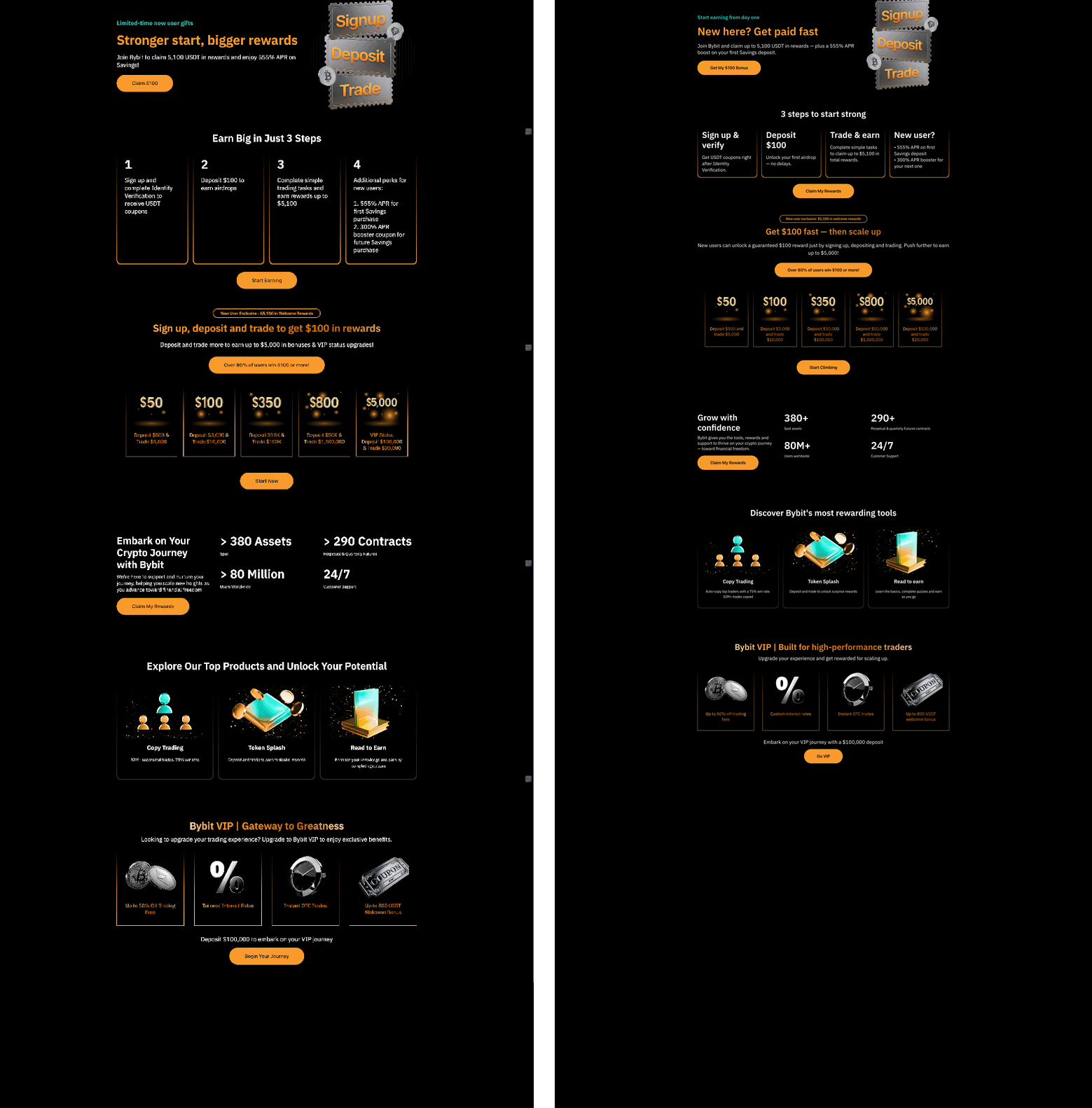
Starting with in-app marketing popups, where stakes were high and results trackable, the first test compared a minimal, product-focused Version A against a more direct, benefit-led Version B. Version B lifted the popup’s conversion rate by a statistically significant 38%. That was the first time product managers and executives saw copy’s impact in numbers instead of hearing about it.
The framework then expanded to landing pages, where a rewrite built around reassurance rather than description took conversions to 7%. Each test was documented with a hypothesis, variant rationale and result, building a model the wider team could reuse.
Found signal in localisation
Testing optimised English copy against market-specific variants showed results diverging sharply by region — Brazil responded to upbeat, urgency-driven language, Indonesia to neutral, formal phrasing. That became the evidence base for a more structured multilingual copy strategy, later featured in a panel session at TransPerfect NEXT 2025.
Results
- 38% conversion lift from a single popup copy test
- 7% conversion rate on a rewritten landing page
- Set the foundation for stronger content-product workflow integration
Want this run on your content?
The first audit is complimentary. Two days from kickoff to write-up.
Related reading

Using A/B testing to prove the value of content design (Button Events)
The full first-hand account of this exact programme

Bybit Card
The workflow rebuilt on the credibility this testing programme earned
GUIDE · 9 min
UX writing 101, and why it matters in marketing
The method behind what these numbers proved